State
The wavefunction ψ encodes probability amplitudes. Different measurements can use different representations of the same state.
01 • QUANTUM MECHANICS
In quantum theory, a system is described by a state that predicts probabilities for measurement outcomes.
The Schrödinger equation: the quantum analogue of a law of motion that governs the evolution of the wavefunction.
The wavefunction ψ encodes probability amplitudes. Different measurements can use different representations of the same state.
Physical quantities are represented by operators. Possible measurement results are tied to their eigenvalues.
Outcome probabilities are given by the Born rule, while the specific experimental outcome is random.
UNCERTAINTY PRINCIPLE
You cannot make the position and momentum distributions arbitrarily narrow at the same time. This is not an instrument flaw, but a feature of quantum description.
FROM MODEL TO TECHNOLOGY
Controlled transitions between energy levels create coherent light.
Quantum properties of band structure underpin modern microelectronics.
Ultra-sensitive measurements use coherence, spins and interference.
INTERACTIVE TOOL
For position uncertainty Δx, the uncertainty principle gives a lower bound for Δp: Δp ≥ ℏ/(2Δx).
Uses ℏ = 1.054571817 × 10⁻³⁴ J·s. This is an ideal lower bound, not a measurement prediction.
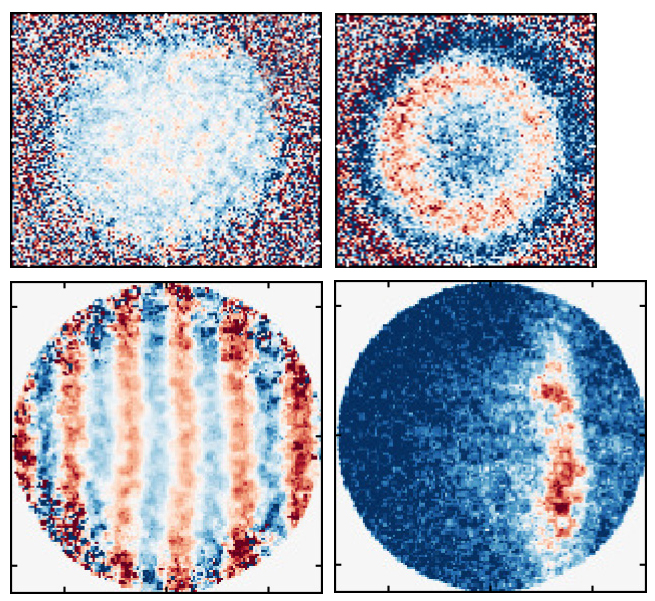
NIST/JILA uses imaging techniques to study atoms prepared in quantum superposition and their measurement.